Sunday, 6 April 2014

Women In The Great, Big Indian Elections

The first phase of the great, big Indian elections is taking place in Assam today. While the country is gearing up for these elections, one common thread that lies between both the United Progressive Alliance (UPA) and the National Democratic Alliance (NDA) is the role that women play in these elections.  
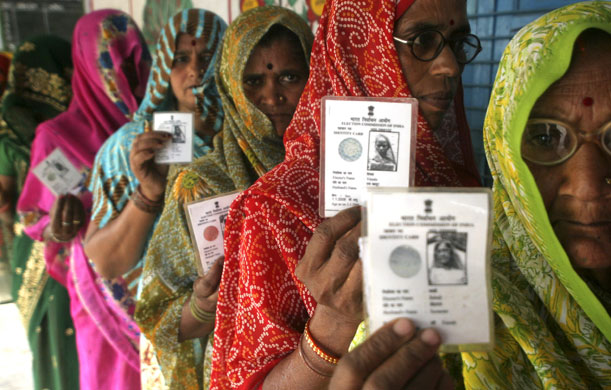
According to reports women make up 48.5% of the electorate and the country is expected to witness a greater turnout of women voters than men. These elections will prove important to women and their empowerment in the future.

Political parties are making various fleeting promises to women in order to win their vote. These promises range from free pressure cookers, free gas connections, free electricity, women’s safety and the promise of jobs. The safety of women has become especially important ever since the gang rape of a young girl in Delhi in December 2012.

From these promises alone it becomes obvious that our traditional outlook towards women still remains as one of a women in her home and in the kitchen. Nevertheless, the power of a woman in her own home is often misunderstood and downplayed.

Despite promises of free pressure cookers and the general “empowerment” of women, it is important to change women’s mindsets towards these elections. Women are to a large extent decision makers in their houses. They may not necessarily be the bread-winners but they do have control over money and the spending of money. They look after their children and are the sole decision makers in terms of controlling their children’s lives – when do they go to school, how much nutrition must they eat and what medication they get. In these terms, it is important to shape the minds of women and educate them so that the country can witness their widespread participation in these elections.

The number of women candidates and the voter turnout that we are witnessing today is already an indicator towards women empowerment. It is a positive sign. ICT too can help in spreading awareness and the benefits of voting and what women can and cannot achieve through these democratic elections.


Bibliography


Malnutrition Among Women in India


Malnutrition, in simple terms, occurs when a person is not given adequate food in the right proportions and with the necessary nutrients. It can lead to stunted growth and reduced mental development during a person’s growing years. Malnutrition is more prevalent in developing countries and is a serious cause of concern. Malnutrition among women is of extreme importance for many reasons.

To begin with, a malnourished woman in most cases also implies a malnourished child. A pregnant malnourished woman can give birth to underweight babies. In turn, the health of babies is largely affected and leads to stunted growth, low immunity and a higher risk of diseases for the entire period of their lives.
For women, malnutrition can significantly increase chances of childbirth. It reduces their immunity and they become more susceptible to a wide range of diseases. Moreover, when a mother is malnourished herself, chances of her children being malnourished are also high.

In a paper titled ‘Factsheet on Women’s Malnutrition in India’, the researchers claimed that “India has not only a large number of malnourished women, it also has one of the highest proportions of malnourished women in the developing countries” (Jose & Navaneetham, 2008)

Many factors contribute to malnutrition among women in India. However, a causal relationship between any one factor and malnutrition cannot be formed. Poverty, illiteracy and lack of autonomy for women in the household have been blamed. Despite India’s incredible economic performance in the last decade, malnutrition among women still persists. Svedberg (2008) found that 54% of India’s population is still employed in the rural, agricultural economy. This implies that despite the country’s impressive economic growth, social growth has staggered. The economic growth that India has been experiencing is not trickle-down and its effects are not great enough.

Tackling the problem of malnutrition among women in India can help in many ways. Firstly, with women’s greater knowledge of malnutrition and its ill effects, she can help prevent it occurring to her children. She can feed them well and provide them with their necessary nutrients. These children will in turn live longer and healthier. Moreover malnutrition among women implies fatigue and overall lower productivity for women. By tackling the present problem of malnutrition among women in India, we can add to the country’s workforce.
This may seem like a far-fledged idea and claim to make. Nevertheless considering that 54% of the population is a part of India’s agricultural economy, women can contribute on the fields and earn extra money while also contributing at home by helping educate her children and the community about malnutrition. However to achieve this kind of socioeconomic development women must also have control over resources and must be given a bigger say in her own household.

Bibliography

Jose, S., & Navaneetham, K. (2008). A Factsheet on Women's Malnutrition in India. Economic and Political Weekly , 61-67.


Svedberg, P. (2008, November 25). ISID Conference: Why malnutrition in shining India persists*. Retrieved February 26, 2014, from ISID:
http://www.isid.ac.in/~pu/conference/dec_08_conf/Papers/PeterSvedberg.pdf